







Send Message
Privacy statement: Your privacy is very important to Us. Our company promises not to disclose your personal information to any external company with out your explicit permission.


The automotive industry has always been driven by precision. As vehicles become more advanced, incorporating complex mechanical systems, electric powertrains, intelligent electronics, and lightweight structures, the demand for highly accurate manufacturing continues to increase.
Among various manufacturing technologies, CNC machining plays a critical role in producing reliable and high-performance automotive components. From engine parts and transmission housings to battery enclosures and electronic brackets, CNC machining enables manufacturers to create complex geometries with excellent repeatability and dimensional accuracy.
However, achieving consistent quality is not only about advanced machining equipment. A key factor determining the performance of automotive parts is the control of CNC machining tolerances. Proper tolerance management ensures that components fit precisely, function smoothly, and maintain reliability throughout their service life.
For automotive manufacturers, understanding machining tolerances is essential when developing prototypes, optimizing designs, and moving toward mass production.
In manufacturing, tolerance refers to the acceptable variation between a component’s designed dimensions and its actual manufactured dimensions.
A CNC machining drawing may specify a dimension of 25 mm with a tolerance of ±0.02 mm. This means the final part must be produced within the range of 24.98 mm to 25.02 mm to meet the engineering requirements.
While a tolerance difference of only a few microns may appear insignificant, it can have a major impact on automotive performance. Components inside engines, transmissions, braking systems, and electric vehicle assemblies often work under extreme conditions where even small dimensional deviations can affect:
Therefore, controlling CNC machining tolerances is one of the most important aspects of automotive component manufacturing.
Automotive systems are highly integrated. A single vehicle may contain thousands of individual parts that must interact accurately. Each component must meet specific dimensional requirements to ensure smooth assembly and reliable operation.
For example, engine components require precise machining to maintain correct clearances between moving parts. Transmission components depend on accurate positioning to ensure efficient power transfer. In electric vehicles, battery housings and motor components require tight dimensional control to achieve proper installation and thermal performance.
A professional CNC machining process allows manufacturers to achieve this level of precision while maintaining production efficiency.
Beyond assembly accuracy, tighter tolerances also contribute to improved product performance. Well-machined components reduce friction, minimize unnecessary movement, and improve overall system reliability.
The required tolerance level varies depending on the function of the component, material selection, and application requirements.
For general automotive parts, standard CNC machining processes can typically achieve tolerances ranging from ±0.05 mm to ±0.10 mm. However, precision applications often require much tighter control.
Typical ranges include:
| Machining Process | Typical Accuracy |
|---|---|
| CNC Milling | ±0.05 mm – ±0.10 mm |
| Precision CNC Milling | ±0.01 mm – ±0.05 mm |
| CNC Turning | ±0.005 mm – ±0.05 mm |
| 5-Axis CNC Machining | ±0.01 mm or higher precision depending on design |
For critical automotive applications, such as engine systems, transmission components, and EV powertrain parts, manufacturers usually follow strict engineering specifications defined by product designers.
The goal is not simply to achieve the smallest possible tolerance, but to select the correct tolerance that balances performance, manufacturing cost, and production efficiency.

The engine and powertrain systems represent some of the most demanding applications for CNC machining.
Components such as:
must maintain accurate dimensions because they experience continuous mechanical stress and temperature changes.
High-precision machining helps ensure proper component interaction, reducing wear and improving operational efficiency.
The rapid growth of electric vehicles has created new requirements for precision manufacturing.
Compared with traditional vehicles, EV systems introduce more complex requirements for:
Many of these components require lightweight materials such as aluminum alloys, which demand careful machining control due to thermal expansion characteristics.
Through advanced CNC machining technology, manufacturers can produce lightweight yet strong components with consistent dimensional accuracy.
Achieving reliable tolerances requires control throughout the entire manufacturing process. Several factors directly influence machining accuracy.
Different materials respond differently during machining. Aluminum, stainless steel, titanium, and engineering plastics each have unique properties that affect dimensional stability.
Factors such as:
must be considered during process planning.
For example, aluminum components used in automotive applications are lightweight and easy to machine, but temperature changes during machining can influence final dimensions if not properly controlled.
The accuracy of CNC equipment directly determines the achievable tolerance range.
Modern CNC machining centers provide advantages such as:
For complex automotive components, 5-axis CNC machining is often used because it can process multiple surfaces in a single setup, reducing positioning errors and improving overall accuracy.
Cutting tools gradually wear during production, which can affect dimensional consistency.
Experienced CNC manufacturers carefully monitor:
Optimized machining parameters help maintain stable quality throughout both prototype production and high-volume manufacturing.
Precision manufacturing requires more than accurate machining equipment. Comprehensive inspection is essential to verify that every component meets design requirements.
Common inspection methods include:
These quality control processes ensure that automotive components maintain consistent accuracy before delivery.
Although tighter tolerances provide higher accuracy, achieving extremely strict tolerances may increase manufacturing complexity and cost.
Therefore, successful automotive manufacturing requires a balance between precision requirements and production efficiency.
Experienced CNC machining suppliers work closely with engineers during the design stage to determine appropriate tolerance levels. Through Design for Manufacturing (DFM) optimization, manufacturers can identify unnecessary tolerance requirements and improve production efficiency without compromising product performance.
This approach is especially valuable for automotive companies developing prototypes or scaling from small-batch production to large-volume manufacturing.
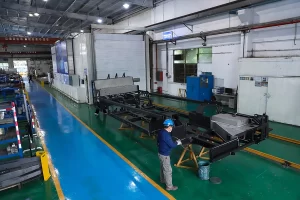
A reliable CNC machining partner provides more than machining services. They support the entire manufacturing process, from initial design validation to final production.
Professional suppliers typically offer:
For automotive companies, this integrated capability reduces development time, improves product consistency, and accelerates the transition from concept to production.
As automotive technology continues to evolve, precision manufacturing has become increasingly important. Whether producing traditional mechanical components or advanced electric vehicle systems, controlling CNC machining tolerances is essential for achieving reliable performance and long-term durability.
Advanced CNC machining technology provides automotive manufacturers with the ability to create complex parts with exceptional accuracy, repeatability, and flexibility. By selecting the right machining processes, materials, and tolerance standards, manufacturers can achieve the ideal balance between quality and cost.
For companies seeking dependable automotive components, partnering with an experienced CNC machining manufacturer ensures that every part meets demanding engineering requirements and supports the future of automotive innovation.
Discover how CTT Technology manufactures precision automotive parts—from engineering design to mass production. Explore our expertise in heavy truck components, bus chassis panels, CNC machining services, and custom CNC parts.
Explore compliance-driven precision manufacturing for medical devices, including custom production, full quality control, and engineering support for imaging, diagnostics, and life science equipment.
Discover precision metal parts for robotics with custom sheet metal fabrication, CNC machining, and scalable manufacturing solutions.
Benefiting from the booming biopharmaceutical industry and accelerated domestic substitution, the market for core equipment solutions for life sciences is experiencing rapid growth. This article focuses on global and Chinese market size forecasts, dissecting the core drivers of industry growth to help seize industry development opportunities.
Email to this supplier
Author:
Ms. CTT TECHNOLOGY (UK) LIMITED
E-mail:
Phone/WhatsApp:

Privacy statement: Your privacy is very important to Us. Our company promises not to disclose your personal information to any external company with out your explicit permission.