






Send Message
Privacy statement: Your privacy is very important to Us. Our company promises not to disclose your personal information to any external company with out your explicit permission.


The biopharmaceutical industry relies on sophisticated equipment to support drug development, biological research, pharmaceutical manufacturing, and laboratory testing. From bioreactors and fluid handling systems to analytical instruments and laboratory automation platforms, every piece of equipment depends on components that meet specific dimensional, mechanical, and environmental requirements.
As biopharmaceutical technologies continue to advance, manufacturers need reliable production partners capable of delivering complex components with consistent quality. Precision machiningfor biopharmaceutical equipment plays an important role in this process, enabling the production of custom metal parts, structural components, mounting brackets, equipment housings, and other precision-engineered solutions.
However, successful manufacturing involves more than achieving tight dimensional tolerances. Material selection, component geometry, surface finishing, assembly requirements, and quality control must all be considered during product development.
This article explores the key material and design considerations involved in manufacturing precision components for biopharmaceutical equipment, helping equipment manufacturers make informed decisions from initial prototyping to production.
Biopharmaceutical equipment does not require every component to have the same tolerance. Instead, precision should be determined by the function of each feature.
Mounting plates may require accurate hole positioning, while structural brackets may require controlled flatness and alignment. Housings and mechanical interfaces may also need consistent dimensions to ensure proper assembly.
CNC machining can produce these custom components according to engineering drawings and CAD models, including:
By applying tighter tolerances only where necessary, manufacturers can balance accuracy, machining time, production cost, and assembly requirements.
Precision-engineered components are used across a wide range of biopharmaceutical and laboratory systems. Understanding their applications helps manufacturers select suitable production methods and identify potential design improvements.
Bioreactors support biological processes used in research and biopharmaceutical production. Depending on the equipment design, associated components may include mounting brackets, structural supports, equipment frames, access panels, and custom mechanical interfaces.
Components exposed to process fluids require particular attention to material compatibility, cleanability, corrosion resistance, and applicable hygiene requirements. These considerations must be evaluated according to the equipment's intended use rather than applied uniformly to every component.
Automated laboratory platforms integrate sample handling, positioning mechanisms, analytical instruments, and electronic controls. Their performance depends partly on the dimensional consistency of structural and mechanical components.
CNC machining can produce mounting plates, brackets, supports, and precision housings that help maintain alignment between interconnected modules.
Custom sheet metal fabrication also supports the production of equipment covers, protective enclosures, control cabinets, and structural panels.
Analytical instruments used in biopharmaceutical research often require carefully manufactured housings, mounting structures, and mechanical interfaces.
These components may need to accommodate sensitive sensors, optical assemblies, electronic modules, or fluid handling mechanisms. Depending on their function, relevant manufacturing considerations include dimensional stability, vibration resistance, thermal management, and ease of assembly.
Fluid handling systems may incorporate manifolds, connectors, mounting blocks, support structures, and custom interfaces.
Where machined components contact process fluids, engineers must evaluate material compatibility, surface finish, cleaning procedures, and applicable process requirements. Components intended for non-product-contact applications may have different specifications.
Clear distinctions between these requirements help avoid unnecessary manufacturing complexity while ensuring that critical features receive appropriate attention.
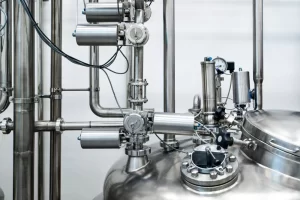
Material selection directly influences component durability, corrosion resistance, machinability, weight, and total manufacturing cost. The appropriate material depends on the operating environment, mechanical loads, cleaning procedures, and whether the component contacts process fluids.
Stainless steel is widely used in pharmaceutical and bioprocessing equipment because selected grades offer good corrosion resistance, mechanical strength, and compatibility with many cleaning environments.
Grades such as 304 and 316L may be considered for different applications. Grade 316L is often selected for components requiring enhanced resistance to certain corrosive environments, although actual performance depends on the chemical exposure, temperature, surface condition, and operating conditions.
Potential applications include structural components, equipment interfaces, brackets, and selected fluid-contact parts.
When machining stainless steel, manufacturers should consider tool selection, heat generation, work hardening, burr removal, and the required surface finish. These factors can influence dimensional consistency and the quality of the finished component.
Aluminum alloys offer a useful combination of low weight, machinability, and strength for many equipment structures.
They are commonly considered for instrument housings, mounting plates, support brackets, protective enclosures, and other components where weight reduction is beneficial.
However, aluminum's suitability depends on the application. Exposure to cleaning chemicals, moisture, or other aggressive environments may require additional evaluation and appropriate surface treatments.
Anodizing may be suitable for certain aluminum components, depending on functional, dimensional, and environmental requirements.
Engineering plastics may be appropriate for insulating components, lightweight structural parts, guides, spacers, and selected fluid handling applications.
Material options can include PEEK, POM, PTFE, and other application-specific polymers.
These materials differ considerably in chemical resistance, stiffness, thermal stability, wear behavior, and dimensional stability. Engineers should therefore evaluate the intended operating conditions before selecting a polymer.
For example, a plastic suitable for a low-load positioning component may not be appropriate for an application involving elevated temperatures, aggressive cleaning agents, or sustained mechanical stress.
Before finalizing material specifications, equipment designers should evaluate:
Material selection should be based on the component's actual function rather than on a general assumption that every biopharmaceutical equipment part requires the same material grade.
A component's design significantly affects its manufacturability, dimensional accuracy, production cost, and assembly performance.
Considering manufacturing requirements during the design stage can help prevent avoidable rework and shorten development cycles.
Not every dimension requires the same tolerance. Specifying extremely tight tolerances across an entire component can increase machining time, inspection requirements, and production costs without improving its functionality.
Engineers should identify critical dimensions according to assembly relationships, movement requirements, sealing interfaces, and other functional considerations.
For example, a mounting hole used to position a precision instrument may require tighter control than a clearance hole in an external cover.
Geometric characteristics such as flatness, perpendicularity, and position may also affect assembly performance. Appropriate drawings and clearly defined inspection requirements help manufacturers understand which features are most important.
Complex geometries can introduce additional manufacturing challenges. Deep pockets, narrow slots, thin walls, and difficult-to-access features may require specialized tooling or additional machining operations.
Design for Manufacturability (DFM) helps identify these issues before production begins.
Practical design improvements may include:
These adjustments can improve manufacturing efficiency while preserving the component's intended performance.
Biopharmaceutical equipment often combines machined parts, sheet metal panels, electrical components, and purchased assemblies.
Designers should consider how individual components will be positioned, fastened, adjusted, and maintained during equipment assembly.
Hole patterns, mounting surfaces, connector openings, cable routing, and access clearances should be evaluated together rather than designed independently.
A manufacturing partner involved early in the development process can review these interfaces and identify potential assembly issues before they affect production.
Although CNC machining is essential for producing precision components, many biopharmaceutical equipment projects also require custom sheet metal fabrication.
Sheet metal processes are particularly useful for manufacturing equipment enclosures, protective covers, electrical cabinets, access panels, and supporting structures.
Typical manufacturing operations may include laser cutting, punching, bending, welding, and finishing, depending on the supplier's capabilities and project requirements.
For biopharmaceutical equipment manufacturers, sheet metal components must often balance structural strength, accessibility, cleanability, appearance, and integration with internal mechanical systems.
Several design considerations are particularly important.
Bend geometry: Appropriate bend radii, flange dimensions, and spacing help avoid deformation and interference during fabrication.
Weld accessibility: Joint design and access requirements should be considered early when welded assemblies are needed.
Panel alignment: Consistent dimensions and well-designed mounting features help ensure that panels fit correctly during final assembly.
Surface treatment: Finishing requirements should reflect the material, environment, cleaning procedures, and appearance specifications.
Service access: Removable panels and suitable access openings can simplify inspection, maintenance, and equipment servicing.
Combining precision machining with sheet metal fabrication can also reduce coordination between separate suppliers. Depending on the project, an integrated manufacturing approach may simplify component sourcing, assembly planning, and production management.

Biopharmaceutical equipment development frequently involves multiple design iterations. Engineers may need to verify component fit, evaluate structural performance, and refine interfaces before committing to larger production quantities.
Rapid prototyping allows teams to produce functional parts for early-stage testing and design validation.
CNC machining is especially useful when prototypes must use representative production materials or incorporate features that are difficult to reproduce through simpler methods.
After the design has been validated, low-volume production can support pilot equipment builds, product launches, and specialized instrument manufacturing. Larger production runs then require consistent process planning, material sourcing, inspection, and production scheduling.
A capable manufacturing partner should consider scalability from the beginning.
Important considerations include tooling accessibility, standardized features, repeatable setups, inspection planning, and opportunities to reduce unnecessary machining operations.
Early collaboration can also help identify design changes that improve manufacturability without compromising performance.
CTT technology provides custom manufacturing solutions for customers across industries including medical devices, electronics, automotive, aerospace, industrial equipment, and life science instrumentation.
Our manufacturing services support projects ranging from rapid prototypes and low-volume production to high-volume manufacturing, with solutions tailored to specific component designs and customer requirements.
For biopharmaceutical equipment manufacturers, precision machining and custom sheet metal fabrication can support the production of equipment housings, mounting brackets, structural components, precision interfaces, and other custom-engineered parts.
By considering material selection, component geometry, manufacturing processes, and quality requirements together, equipment developers can improve manufacturability and build a more reliable path from initial design to production.
Whether you are developing a new laboratory instrument, refining an existing bioprocessing system, or sourcing custom components for a specialized equipment platform, early manufacturing collaboration can help identify potential challenges and improve project efficiency.
Precision machining is an important manufacturing process for biopharmaceutical equipment, supporting the production of components that must meet defined dimensional, mechanical, and environmental requirements.
Successful outcomes depend on more than machining accuracy. Material selection, design for manufacturability, surface finishing, assembly integration, and quality control all contribute to component performance and production consistency.
By evaluating these factors early and working with a capable manufacturing partner, biopharmaceutical equipment manufacturers can reduce avoidable design revisions, improve production efficiency, and support a smoother transition from rapid prototyping to volume manufacturing.
For companies seeking custom precision components, combining CNC machining with sheet metal fabrication offers a flexible approach to developing equipment structures, enclosures, and engineered parts for demanding laboratory and bioprocessing applications.
Explore precision machining for biopharmaceutical equipment, including material selection, design optimization, sheet metal fabrication, and quality control.
Explore aerospace sheet metal processing, from precision cutting and forming to welding and finishing, for reliable custom aerospace components.
Discover how advanced CNC technology is transforming custom machined parts with higher precision, faster production, flexible volumes, and smarter manufacturing.
Learn how CNC machining tolerances impact automotive component accuracy and reliability, including standards, key factors, and precision manufacturing solutions.
Email to this supplier
Author:
Ms. CTT TECHNOLOGY (UK) LIMITED
E-mail:
Phone/WhatsApp:

Privacy statement: Your privacy is very important to Us. Our company promises not to disclose your personal information to any external company with out your explicit permission.