








Send Message
Privacy statement: Your privacy is very important to Us. Our company promises not to disclose your personal information to any external company with out your explicit permission.


Aerospace manufacturing demands more than simply producing metal parts. Components used in aircraft, spacecraft, unmanned systems, and aerospace equipment must meet demanding requirements for dimensional accuracy, structural integrity, repeatability, and quality control. Even relatively simple parts such as brackets, panels, covers, and mounting components can play an important role in the overall performance and reliability of an aerospace system.
This is where sheet metal processing becomes an important manufacturing solution. By combining precision cutting, forming, bending, machining, welding, finishing, and inspection, manufacturers can produce lightweight and durable components with complex geometries and consistent dimensions.
For aerospace applications, however, conventional fabrication is not always enough. Aerospace sheet metal processing requires careful material selection, controlled manufacturing processes, accurate interpretation of engineering drawings, and reliable quality inspection.
For companies developing prototypes, validating new designs, or producing low- to high-volume aerospace components, choosing the right manufacturing partner can directly affect product quality, production efficiency, and time to market.
Aerospace sheet metal processing refers to a series of manufacturing processes used to transform sheet metal into components for aircraft, spacecraft, aerospace equipment, and related systems.
Depending on the component design, the manufacturing process may include:
Unlike general-purpose sheet metal fabrication, aerospace applications often require tighter control over dimensions, materials, joining methods, surface quality, and documentation.
The objective is not simply to manufacture a part according to a drawing. The process must consistently produce parts that satisfy the engineering requirements and remain suitable for integration into a larger aerospace assembly.
Quality systems are particularly important in this industry. The International Aerospace Quality Group (IAQG) describes the 9100 series as a standardized quality management framework for aviation, space, and defense organizations across the supply chain.
Aerospace components often need to fit together with other precision-manufactured parts. Small dimensional variations can affect alignment, assembly, mounting, sealing, or the performance of the final system.
For this reason, precision sheet metal processing focuses on controlling the entire manufacturing process rather than relying only on final inspection.
Several factors contribute to precision:
Material consistency:
Material properties and thickness can influence cutting, bending, forming, and welding results.
Process control:
Machine parameters, tooling, bending sequences, and welding conditions need to be appropriately controlled for the selected material and component geometry.
Dimensional accuracy:
Critical dimensions, hole locations, bend angles, flatness, and feature positions may need to be verified against engineering specifications.
Repeatability:
A manufacturing process should produce consistent results across prototypes, small batches, and larger production runs.
Inspection:
Measurement and verification help identify deviations before components move further through the manufacturing process.
Aerospace manufacturers and suppliers commonly place strong emphasis on quality systems and supplier controls. Boeing, for example, states that its quality management system is based on AS9100 and notes that major aerospace manufacturers may flow down AS9100 requirements to suppliers.
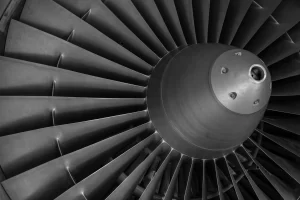
Aerospace components can range from relatively simple brackets to multi-part welded assemblies. The appropriate manufacturing process depends on geometry, material, tolerances, quantity, and application.
Cutting is often the first stage of the manufacturing process. Laser cutting and other CNC-based methods can produce accurate profiles from sheet materials while supporting repeatable production.
For aerospace parts, cutting accuracy is important because the resulting edges and features can influence subsequent bending, assembly, and dimensional performance.
Proper cutting parameters can also help reduce burrs, deformation, and unnecessary secondary operations.
Many aerospace components require bends, flanges, channels, or formed geometries rather than simple flat profiles.
CNC press brakes and forming equipment allow manufacturers to control bend angles and repeat production across multiple parts.
The bending sequence is particularly important for complex components. A well-planned process can reduce deformation and improve consistency while minimizing the need for manual correction.
Some sheet metal components require additional machining after cutting or forming.
Typical secondary operations can include precision holes, slots, threads, countersinks, mounting features, or machined interfaces.
Combining sheet metal fabrication with machining capabilities can reduce the number of suppliers involved in a project and simplify production coordination.
Some aerospace products consist of multiple sheet metal components joined into a larger assembly.
Depending on the design and material, welding can be used to create brackets, frames, housings, structural assemblies, and other custom components.
The challenge is to control heat input, distortion, joint quality, and dimensional accuracy. For precision assemblies, welding should therefore be considered as part of the overall manufacturing strategy rather than as an isolated operation.
Surface finishing can improve appearance, corrosion resistance, wear resistance, or compatibility with the final application.
Depending on project requirements, sheet metal components may undergo processes such as deburring, polishing, coating, anodizing, plating, or other specified treatments.
The appropriate finish should be selected according to the material, operating environment, functional requirements, and customer specifications.
Material selection is another important part of aerospace manufacturing.
Aerospace sheet metal components may use materials selected for combinations of low weight, strength, corrosion resistance, temperature performance, manufacturability, and application-specific requirements.
Common material categories can include:
Material selection should not be based solely on material price or ease of fabrication. Engineers should consider the component's operating environment, mechanical requirements, joining method, surface treatment, and applicable specifications.
Precision manufacturing does not end when the machine completes the part.
For aerospace applications, quality control should be integrated throughout the manufacturing workflow.
A typical quality process can include:
Engineering review → Material verification → Process planning → In-process inspection → Final dimensional inspection → Documentation → Packaging and delivery
This approach helps manufacturers identify potential problems earlier instead of discovering nonconformities only after production is complete.
First Article Inspection is another important concept within aerospace manufacturing. IAQG identifies AS9102 as the aerospace standard establishing requirements for performing and documenting FAI, with the standard designed to align with production-process verification requirements.
For aerospace customers, this means that a capable manufacturing supplier should understand not only how to make the part, but also how to document and verify that the production process consistently meets the defined requirements.
Sheet metal processing can support a wide range of aerospace applications.
Typical components may include:
The manufacturing approach varies depending on whether the component is a prototype, a replacement part, a low-volume production component, or part of a larger production program.
Aerospace projects often move through several manufacturing stages. A design may begin with a prototype, progress to engineering validation, and eventually enter small-batch or larger-scale production.
This makes manufacturing flexibility particularly valuable.
For prototypes, the priority may be rapid turnaround and design verification. For small-batch production, consistency and cost control become increasingly important. For larger production volumes, manufacturers need stable processes, repeatability, efficient material utilization, and reliable quality control.
A manufacturing partner capable of supporting different production volumes can help reduce the need to transfer a component between multiple suppliers as the project develops.
This is particularly relevant to precision sheet metal processing, where maintaining consistency between prototype and production parts can simplify product development and reduce manufacturing risks.
Selecting a supplier involves more than comparing equipment lists or unit prices.
Consider these factors when evaluating a manufacturing partner:
The supplier should be able to understand engineering drawings, 3D CAD models, material specifications, tolerances, and assembly requirements.
Look for a supplier with suitable cutting, bending, machining, welding, finishing, and inspection capabilities for the intended components.
Aerospace supply chains place significant emphasis on quality management. Depending on the project, customers may require specific certifications, inspection procedures, documentation, or traceability. The applicable requirements should always be confirmed against the customer's specifications and contract.
A supplier should ideally support the expected production lifecycle—from rapid prototypes and engineering samples through small-batch and larger-volume manufacturing.
Clear communication regarding drawings, revisions, materials, tolerances, inspection requirements, and delivery schedules can help prevent costly manufacturing errors.
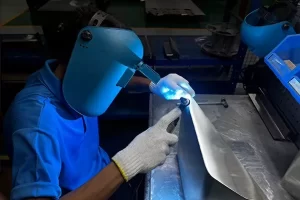
The value of precision sheet metal processing goes beyond dimensional accuracy.
A well-controlled manufacturing process can contribute to:
For aerospace manufacturers, these benefits become especially important when components must integrate with complex assemblies or when production moves from development to repeat manufacturing.
At CTT Technology, custom sheet metal manufacturing is designed to support different stages of product development and production.
From rapid prototypes and low-volume orders to larger production runs, CTT Technology provides custom manufacturing solutions for components ranging from simple brackets to complex welded assemblies.
Our capabilities can support applications across multiple industries, including automotive, electronics, medical devices, aerospace, industrial equipment, and life science instruments.
For aerospace projects, the manufacturing process can be developed around the specific requirements of the component, including material selection, geometry, tolerances, forming, joining, finishing, and inspection.
This flexible approach allows engineering teams to move from concept validation to repeat production without treating every manufacturing stage as a completely separate project.
Sheet metal processing plays an important role in aerospace manufacturing because it provides a practical way to produce lightweight, durable, and precisely formed components across a wide range of geometries and production volumes.
However, aerospace applications require more than basic fabrication. Aerospace sheet metal processing depends on controlled processes, appropriate material selection, dimensional accuracy, repeatability, inspection, and quality management.
From precision cutting and CNC bending to machining, welding, finishing, and inspection, every stage can influence the performance of the final component.
For companies developing new aerospace products or sourcing custom components, choosing a manufacturing partner with flexible production capabilities and a strong focus on precision sheet metal processing can help create a more reliable path from prototype to production.
Discover how CTT Technology manufactures precision automotive parts—from engineering design to mass production. Explore our expertise in heavy truck components, bus chassis panels, CNC machining services, and custom CNC parts.
Explore compliance-driven precision manufacturing for medical devices, including custom production, full quality control, and engineering support for imaging, diagnostics, and life science equipment.
Discover precision metal parts for robotics with custom sheet metal fabrication, CNC machining, and scalable manufacturing solutions.
Benefiting from the booming biopharmaceutical industry and accelerated domestic substitution, the market for core equipment solutions for life sciences is experiencing rapid growth. This article focuses on global and Chinese market size forecasts, dissecting the core drivers of industry growth to help seize industry development opportunities.
Email to this supplier
Author:
Ms. CTT TECHNOLOGY (UK) LIMITED
E-mail:
Phone/WhatsApp:

Privacy statement: Your privacy is very important to Us. Our company promises not to disclose your personal information to any external company with out your explicit permission.