







Send Message
Privacy statement: Your privacy is very important to Us. Our company promises not to disclose your personal information to any external company with out your explicit permission.


In modern manufacturing, sheet metal processing plays a critical role in the production of precision parts across industries such as electronics, automotive, and medical devices. However, selecting the right manufacturing method is not always straightforward. With the advancement of technologies such as CNC machining services, EDM machining, CNC engraving, and CNC cutting, companies must carefully balance precision, cost, and efficiency. This article helps you choose the most suitable processing solution based on project requirements.
Sheet metal processing refers to the transformation of metal sheets into functional components through cutting, bending, and forming operations. Today, it is often combined with precision machining and CNC machining technologies to achieve higher accuracy and more complex geometries.
Professional parts manufacturers typically integrate multiple processes, such as:
In modern sheet metal fabrication and precision manufacturing systems, different machining technologies serve distinct functional roles. By combining multiple processes, manufacturers can improve overall efficiency while maintaining precision and optimizing cost structure, allowing CNC machining services to deliver maximum value across various applications.
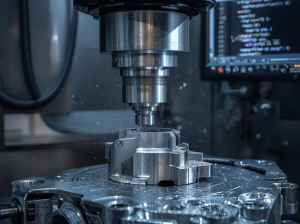
1. CNC Machining Services
CNC machining services are one of the core technologies in modern precision parts manufacturing, widely used for complex components and high-precision parts production. Because CNC machining is controlled by computer numerical systems, it ensures extremely high repeatability and consistency, making it ideal for both high-volume production and strict quality requirements.
In practical applications, CNC machining offers excellent dimensional stability and material adaptability. It can process a wide range of materials, including aluminum alloys, stainless steel, copper, and engineering plastics, giving it strong versatility in metal machining applications. For highly complex and precision-demanding components such as medical device parts, electronic housings, and industrial mechanical structures, CNC machining ensures stable quality and functional consistency, making it an essential process in modern manufacturing systems.
2. CNC Cutting and CNC Engraving
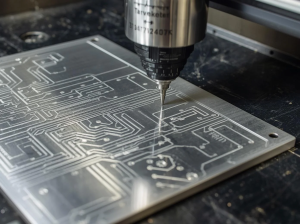
CNC cutting and CNC engraving are primarily used for contour shaping and 2D or shallow 3D structure machining in sheet metal processing. These processes offer high efficiency in shaping metal sheets and are especially suitable for large-format materials.
They are commonly applied in rapid prototyping, early-stage product validation, and medium-precision component production. For projects requiring fast iteration, CNC cutting significantly shortens development cycles while maintaining reliable accuracy. In addition, this process is widely used in manufacturing industrial panels, equipment enclosures, advertising structures, and electronic housings due to its flexibility and cost-effectiveness, making it a key part of modern CNC services systems.
3. CNC Turning and Lathe Machining
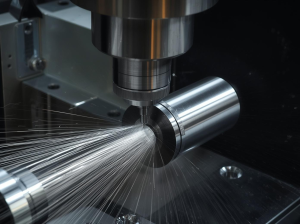
CNC turning is mainly used for machining rotationally symmetric components and is a critical process in precision mechanical part production. Within precision manufacturing systems, it is commonly applied to shafts, bushings, connectors, and various cylindrical components.
During the turning process, the workpiece rotates at high speed while the cutting tool precisely removes material, resulting in excellent surface finish and dimensional accuracy. CNC lathe machining also offers outstanding stability in mass production, making it ideal for industries requiring consistent quality output over long production cycles, such as automotive components, industrial transmission systems, and precision equipment structures.
In modern manufacturing, CNC turning not only improves production efficiency but also reduces human error, serving as an important bridge between metal machining and high-end industrial production.
4. EDM Machining
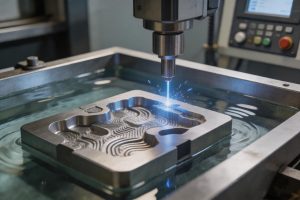
EDM (Electrical Discharge Machining) is a non-contact precision machining technology especially suitable for processing hard materials and complex geometries that are difficult to achieve with traditional cutting methods. In precision parts manufacturing, EDM offers unique advantages that are difficult to replace.
This process can machine extremely hard materials such as hardened steel and carbide, and it is capable of producing highly complex 3D geometries. It is widely used in mold manufacturing, micro-feature machining, and high-precision internal cavity processing. Since EDM is a non-contact process, it does not generate mechanical stress or deformation, making it particularly suitable for components requiring extremely high precision and structural stability.
In modern CNC machining services, EDM is often combined with traditional CNC processes to complete complex part manufacturing, achieving a higher level of precision and broader process capability coverage.
1. Material Type
Different materials require different processing methods. For example, aluminum is well-suited for CNC cutting, while stainless steel is better processed through precision machining or EDM machining.
2. Structural Complexity
Highly complex geometries are better suited for CNC machining services, while simpler structures can be efficiently produced using sheet metal processing or cutting methods.
3. Production Volume
Low-volume production is typically ideal for CNC machining, while high-volume production benefits from automated sheet metal fabrication combined with CNC processes to improve efficiency and reduce unit cost.
4. Cost vs Precision Balance
Higher precision generally leads to higher production costs. Therefore, selecting the right combination of machining processes is essential to achieve an optimal balance between cost efficiency and product accuracy.
An integrated CNC services provider that combines CNC cutting, CNC turning, and full machining capabilities plays a critical role in modern precision manufacturing. By managing all processes under one system, manufacturers can ensure consistent quality control across every production stage, reducing errors caused by multiple suppliers. This integration also helps optimize production planning, minimize material handling, and significantly lower overall manufacturing costs. In addition, streamlined workflows improve communication efficiency and eliminate delays between processes, resulting in much shorter lead times. For complex precision parts, a one-stop CNC machining solution ensures better reliability, faster delivery, and more stable product quality, making it a key advantage in today’s competitive metal machining industry.
In conclusion, choosing the right sheet metal processing method is essential for achieving high-quality machining parts while controlling costs. By combining technologies like CNC machining, CNC cutting, EDM machining, and CNC turning, manufacturers can deliver superior results across various industries.
Working with an experienced parts manufacturer ensures that every stage—from design to production—is optimized for performance, precision, and efficiency.
Ready to get started? Request a quote online or call us at 86-133-1896-6480
CTT Technology focuses on one-stop services for non-standard metal parts customization, integrating design, processing, and testing to provide efficient and accurate personalized customization solutions for industries such as equipment manufacturing and precision instruments, helping companies reduce costs and increase efficiency.
Precision flexible intelligent manufacturing is the core driving force for the upgrading of core equipment solutions for life sciences. From precision component processing to complete system integration, it realizes the intelligent manufacturing upgrade of the entire industrial chain of core equipment for life sciences, contributing to the high-quality development of the biopharmaceutical industry.
A biological safety cabinet (BSC) provides essential protection for laboratory personnel, samples, and the environment when handling hazardous microorganisms. This article explains BSC functions, material requirements, manufacturing and safety standards, and key testing procedures. It also highlights the differences between biological safety cabinets and laminar flow hoods, helping users select the proper equipment for their laboratory. Through clear guidance on certification and maintenance, the article supports safer, more efficient laboratory operations.
Learn the importance of inkjet printer shell design, including material selection, structural requirements, manufacturing processes, maintenance methods, and solutions for common shell failures. Improve durability, stability, heat dissipation, and overall performance of industrial inkjet printers with expert guidance.
Email to this supplier

Privacy statement: Your privacy is very important to Us. Our company promises not to disclose your personal information to any external company with out your explicit permission.