









Send Message
Privacy statement: Your privacy is very important to Us. Our company promises not to disclose your personal information to any external company with out your explicit permission.


A biological safety cabinet (BSC) is a specialized device designed to provide safe containment when handling biological materials in laboratory or medical environments. Its primary function is to prevent harmful microorganisms or viruses from contaminating personnel, samples, and the surrounding environment. Through HEPA filtration and controlled airflow, BSCs create a stable and safe workspace, significantly improving experimental accuracy and reducing the risk of cross-contamination.
Different classes of BSCs meet varying protection levels. Class I cabinets are suitable for low-risk microbiological operations, while Class III cabinets are designed for high-risk pathogens. Understanding their classification and protective capacity ensures laboratories select equipment that meets their safety requirements.
Choosing the right materials for a BSC is critical for safety, lifespan, and ease of maintenance.
Galvanized steel is cost-effective but has lower durability and corrosion resistance, making it unsuitable for long-term exposure to disinfectants or chemicals. Stainless steel, by contrast, provides superior corrosion resistance, maintains hygienic conditions, and withstands frequent cleaning—making it the preferred material in professional laboratories.
Many internal components require specialized plastics with strong chemical resistance. Since BSCs often come into contact with various reagents, plastics used must resist aging, deformation, and corrosion. Easy-to-clean surfaces are essential to maintain sterile conditions and ensure long-term reliability.
In summary, material selection directly affects safety performance, maintenance efficiency, and operational reliability.

Strict manufacturing standards are essential for ensuring the performance and safety of biological safety cabinets.
A well-engineered structure ensures containment integrity and prevents microorganisms from leaking into the environment. Properly designed airflow channels and sealed workspaces form the foundation of effective bio-containment.
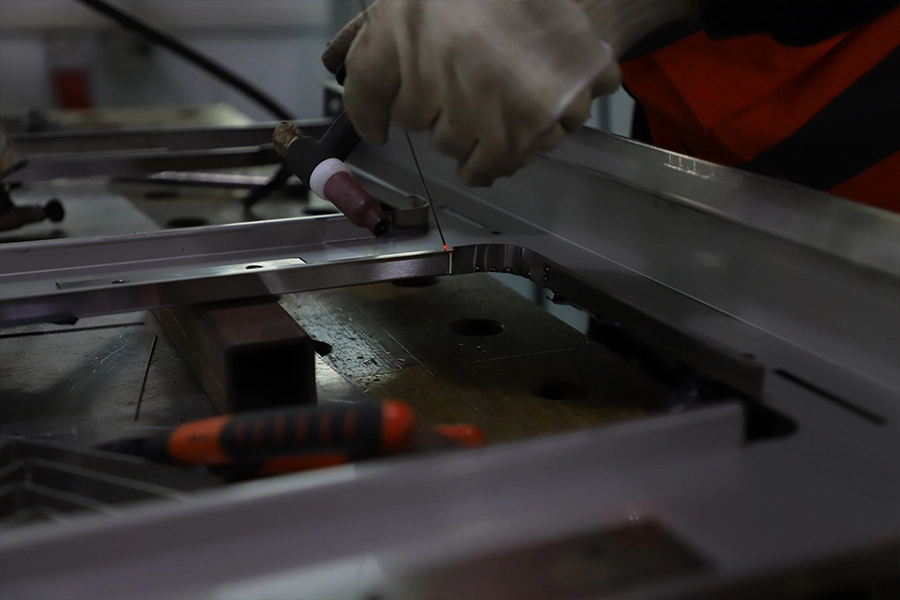
BSCs must feature seamless welding to avoid cracks and crevices where contaminants could accumulate. High-quality sealing prevents air leakage, improves cleaning convenience, and enhances cabinet durability. The precision installation of filters and blowers ensures consistent airflow and purification efficiency.
Following these process standards guarantees stable operation, improved safety, and user confidence in high-risk laboratory settings.
Although biological safety cabinets and laminar flow hoods (clean benches) appear similar, they serve distinct functions and should not be used interchangeably.
BSC: Protects personnel, samples, and environment from biological hazards.
Laminar Flow Hood: Only protects samples from contamination; does not protect the operator.
BSCs use negative pressure and HEPA filters to prevent pathogen escape. Laminar flow hoods create unidirectional airflow to maintain a particle-free workspace.
BSC: Handling infectious agents, biological samples, and potentially hazardous materials.
Laminar Hood: Sterile sample handling, cell culture, aseptic assembly—not for pathogens.
Choosing the right device is essential for both safety regulations and experiment success.

Regular testing and certification are essential to ensure a biological safety cabinet maintains optimal protection.
Routine tests include:
Airflow velocity measurement
HEPA filter efficiency testing
Leak and containment tests
These procedures ensure airflow integrity and contamination control.
BSCs must comply with recognized international standards, such as:
ISO 14644
EN 12469
NSF/ANSI 49 (for Class II BSCs)
Each cabinet must pass official inspection before being certified for use.
Labs must conduct:
Yearly comprehensive testing
Performance documentation
Preventive maintenance for blowers, filters, and seals
This ensures long-term compliance and reliable protection for laboratory personnel.

Explore aerospace sheet metal processing, from precision cutting and forming to welding and finishing, for reliable custom aerospace components.
Discover how advanced CNC technology is transforming custom machined parts with higher precision, faster production, flexible volumes, and smarter manufacturing.
Learn how CNC machining tolerances impact automotive component accuracy and reliability, including standards, key factors, and precision manufacturing solutions.
Discover how precision machining supports HPP equipment manufacturing with high-quality custom metal parts, CNC machining, and sheet metal fabrication solutions.
Email to this supplier
Author:
Ms. CTT TECHNOLOGY (UK) LIMITED
E-mail:
Phone/WhatsApp:

Privacy statement: Your privacy is very important to Us. Our company promises not to disclose your personal information to any external company with out your explicit permission.