







Send Message
Privacy statement: Your privacy is very important to Us. Our company promises not to disclose your personal information to any external company with out your explicit permission.


The automotive industry is under constant pressure to manufacture lighter, safer, and more cost-effective vehicles. As advanced high-strength steels (AHSS) and ultra-high-strength steels (UHSS) become increasingly common, hot forming has emerged as one of the most effective manufacturing methods for producing structural components with exceptional strength.
However, hot forming is also one of the most expensive manufacturing processes. Material waste, tooling costs, energy consumption, and secondary machining operations can significantly increase production expenses.
Modern laser cutting technology is changing this equation.
By delivering exceptional laser cutting accuracy, maintaining consistent laser cutting tolerances, and complying with international laser cutting tolerance standards, laser cutting helps manufacturers reduce overall hot forming costs while improving product quality and production efficiency.
This article explores how laser technology transforms automotive manufacturing and why precision laser cutting has become an essential part of today's supply chain.
Hot forming, also known as press hardening, involves heating steel blanks to approximately 900–950°C before transferring them into specially designed dies where they are simultaneously formed and rapidly cooled.
The process enables manufacturers to produce components with tensile strengths exceeding 1,500 MPa while reducing vehicle weight.
Typical hot formed components include:
Although highly effective, hot forming introduces several manufacturing challenges:
These challenges make upstream cutting accuracy more important than ever.
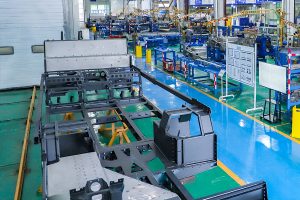
One of the greatest advantages of fiber laser cutting is its exceptional laser cutting accuracy.
Modern laser systems can routinely achieve positioning accuracy within ±0.05 mm depending on material type, machine calibration, and processing conditions.
This level of precision provides several advantages:
Each blank matches the CAD design with minimal deviation, improving downstream forming performance.
Accurate cutting minimizes dimensional defects that often cause rejected formed parts.
Consistent blanks distribute forming forces more evenly, reducing excessive die wear.
Precisely cut components fit together with less adjustment during robotic welding and assembly.
Laser cutting tolerances refer to the acceptable dimensional variation between the designed geometry and the finished component.
Tolerance capability depends on several factors:
Typical laser cutting tolerances include:
| Material Thickness | Typical Laser Cutting Tolerances |
|---|---|
| 0.5–2 mm | ±0.05–0.10 mm |
| 2–5 mm | ±0.10–0.20 mm |
| 5–10 mm | ±0.20–0.30 mm |
| >10 mm | ±0.30 mm or higher |
Maintaining tight tolerances ensures predictable forming behavior and reduces costly secondary operations.
Meeting recognized laser cutting tolerance standards is essential for OEMs and Tier suppliers.
Common standards include:
Defines thermal cutting quality including:
General tolerances for linear and angular dimensions where specific tolerances are not individually specified.
Many automotive manufacturers implement additional internal specifications requiring tighter tolerances than international standards.
Reliable fabrication partners consistently inspect parts using:
Quality verification ensures every production batch meets customer expectations.
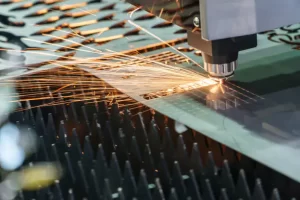
Optimized nesting software significantly improves material utilization.
Higher nesting efficiency means fewer steel sheets are required to produce the same number of parts.
Laser cutting eliminates many dedicated trimming tools traditionally required in hot forming.
Design modifications can often be implemented through software rather than expensive tool replacement.
Precise cutting minimizes the need for:
This shortens production cycles and lowers labor costs.
Prototype blanks can be produced directly from CAD files without manufacturing hard tooling.
This dramatically shortens development cycles for:
Unlike stamping dies, laser cutting programs can be changed within minutes.
Manufacturers can efficiently produce:
without major production interruptions.
Achieving consistent laser cutting accuracy requires more than advanced equipment.
An experienced fabrication partner should provide:
A supplier capable of integrating cutting, bending, welding, machining, and assembly can significantly simplify the automotive supply chain.
Precision sheet metal fabrication plays a vital role in modern automotive manufacturing by ensuring consistent quality, tighter dimensional control, and greater production efficiency. When advanced laser cutting is integrated with CNC bending, welding, machining, and rigorous quality inspection, manufacturers can produce components with superior fit, reduced material waste, and fewer secondary operations. A reliable fabrication partner capable of supporting rapid prototyping, low-volume production, and high-volume manufacturing also helps streamline the supply chain, accelerate product development, and reduce overall manufacturing costs. For automotive companies seeking higher performance and long-term competitiveness, precision sheet metal fabrication is a strategic investment that delivers both operational and economic benefits.
As automotive manufacturers continue pursuing lightweight designs, stronger materials, and more efficient production, laser cutting has become a critical technology for reducing hot forming manufacturing costs.
Superior laser cutting accuracy improves forming consistency, while tight laser cutting tolerances reduce scrap, minimize secondary operations, and extend tooling life. Compliance with recognized laser cutting tolerance standards further ensures reliable quality across prototype, low-volume, and mass production.
For companies seeking high-performance custom sheet metal fabrication, investing in precision laser cutting is no longer simply a manufacturing upgrade—it is a strategic advantage that drives quality, efficiency, and long-term competitiveness across the automotive supply chain.
Explore precision machining for biopharmaceutical equipment, including material selection, design optimization, sheet metal fabrication, and quality control.
Explore aerospace sheet metal processing, from precision cutting and forming to welding and finishing, for reliable custom aerospace components.
Discover how advanced CNC technology is transforming custom machined parts with higher precision, faster production, flexible volumes, and smarter manufacturing.
Learn how CNC machining tolerances impact automotive component accuracy and reliability, including standards, key factors, and precision manufacturing solutions.
Email to this supplier
Author:
Ms. CTT TECHNOLOGY (UK) LIMITED
E-mail:
Phone/WhatsApp:

Privacy statement: Your privacy is very important to Us. Our company promises not to disclose your personal information to any external company with out your explicit permission.