








Send Message
Privacy statement: Your privacy is very important to Us. Our company promises not to disclose your personal information to any external company with out your explicit permission.


CNC machining plays a critical role in the aerospace industry, where precision, reliability, and safety are non-negotiable. Aerospace components must withstand extreme environments, including high pressure, temperature fluctuations, and mechanical stress. As a result, manufacturing standards are significantly higher compared to general industrial parts.
In this article, we explore the key requirements for CNC machining aerospace components and how manufacturers ensure consistent quality and performance.
Aerospace components often demand extremely tight tolerances, sometimes down to the micron level, where even the smallest deviation can have a significant impact on performance and safety. To meet these stringent requirements, advanced CNC machining systems are essential, as they ensure consistent dimensional accuracy across all parts, maintain highly repeatable production quality in both prototypes and mass production, and enable the precise manufacturing of complex geometric structures that are critical to aerospace applications.
Aerospace components are typically made from high-performance materials such as: titanium alloys, aluminum alloys, stainless steel and nickel-based superalloys.
These materials are chosen for their:
However, they are also difficult to machine, requiring specialized CNC equipment and tooling strategies.
Surface integrity directly impacts fatigue resistance and durability. Aerospace components often require ultra-smooth surface finishes to reduce friction and prevent micro-cracks.
Common finishing requirements include:
A superior surface finish extends component lifespan and ensures safe operation.
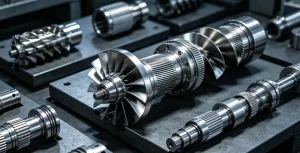
Quality assurance is one of the most important aspects of aerospace CNC machining. Every component must be verified before delivery.
Manufacturers must implement:
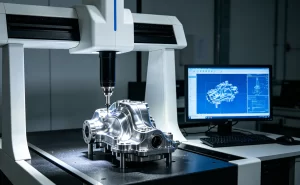
Modern aerospace components often feature intricate structures designed for lightweight efficiency and aerodynamic performance.
CNC machining must support:
This enables the production of highly complex parts in a single setup.
Production consistency and scalability are critical in aerospace manufacturing, whether for rapid prototypes or large-scale production batches. A reliable CNC machining supplier must maintain stable process control throughout the entire manufacturing workflow, ensure scalable production capacity to meet evolving project demands, and deliver uniform quality across all batches without variation. This level of consistency is especially important for long-term aerospace programs, where reliability and repeatability directly impact safety, certification compliance, and overall project success.
CNC machining for aerospace components demands the highest standards of precision, material expertise, and quality control across every stage of production. From maintaining ultra-tight tolerances and machining advanced, difficult-to-cut materials, to meeting strict industry certifications and inspection requirements, each step must be carefully engineered and rigorously controlled to ensure absolute safety, reliability, and long-term performance.
In aerospace applications, there is no room for compromise. Even minor inconsistencies in dimensional accuracy, surface quality, or material integrity can directly impact system functionality and operational safety. This is why manufacturers must not only rely on advanced CNC equipment, but also implement robust process management, skilled engineering support, and comprehensive quality assurance systems.
Ultimately, successful aerospace CNC machining is achieved through the combination of precision technology and disciplined manufacturing practice. By integrating high-end machining capabilities with strict quality standards, manufacturers can consistently deliver components that meet the demanding expectations of the aerospace industry—from initial prototyping to full-scale production programs.
At CTT Technology, we provide precision CNC machining and custom sheet metal solutions to support aerospace, automotive, medical, and other high-demand industries, ensuring reliable performance from prototype to mass production.
Explore aerospace sheet metal processing, from precision cutting and forming to welding and finishing, for reliable custom aerospace components.
Discover how advanced CNC technology is transforming custom machined parts with higher precision, faster production, flexible volumes, and smarter manufacturing.
Learn how CNC machining tolerances impact automotive component accuracy and reliability, including standards, key factors, and precision manufacturing solutions.
Discover how precision machining supports HPP equipment manufacturing with high-quality custom metal parts, CNC machining, and sheet metal fabrication solutions.
Email to this supplier
Author:
Ms. CTT TECHNOLOGY (UK) LIMITED
E-mail:
Phone/WhatsApp:

Privacy statement: Your privacy is very important to Us. Our company promises not to disclose your personal information to any external company with out your explicit permission.