








Send Message
Privacy statement: Your privacy is very important to Us. Our company promises not to disclose your personal information to any external company with out your explicit permission.


As industrial automation continues to reshape manufacturing, the demand for reliable, durable, and precisely engineered automation equipment has never been greater. Whether it's a robotic assembly cell, an automated inspection system, a packaging machine, or a conveyor line, every automation system depends on one often-overlooked component—the equipment enclosure.
An automation equipment enclosure is far more than a protective shell. It safeguards sensitive electrical and mechanical components from dust, moisture, vibration, and accidental impact while improving operator safety and simplifying maintenance. A well-designed enclosure also contributes to efficient heat dissipation, organized cable management, and a professional product appearance, all of which influence the overall performance and lifespan of the equipment.
For OEM manufacturers and industrial equipment builders, investing in a custom sheet metal enclosure can reduce assembly time, improve product reliability, and create a stronger competitive advantage. This article explores the essential design principles, material options, manufacturing processes, and key considerations involved in producing high-quality automation equipment enclosures.
Automation equipment enclosures are protective housings specifically designed to contain and safeguard the electrical, electronic, pneumatic, and mechanical components used in automated machinery. They serve as the interface between sophisticated internal systems and the often harsh industrial environment in which the equipment operates.
Besides protecting valuable components, enclosures help manufacturers comply with industrial safety regulations, improve serviceability, and enhance the overall appearance of the machine. Depending on the application, an enclosure may be as simple as a compact electrical control box or as complex as a fully integrated modular cabinet that houses multiple control systems and mechanical assemblies.
Today, automation equipment enclosures can be found in industries such as automotive manufacturing, medical devices, aerospace, industrial equipment, electronics, life science instruments, semiconductor manufacturing, food processing, and logistics automation.
The performance of an automation system depends not only on its internal components but also on how effectively those components are protected. Without a properly designed enclosure, dust, oil, moisture, excessive heat, or vibration can significantly reduce equipment reliability and increase maintenance costs.
A professionally engineered enclosure helps prevent contamination, protects operators from electrical hazards, minimizes downtime, and extends the service life of expensive control systems. It also improves internal organization by providing dedicated space for cable routing, ventilation, cooling devices, and maintenance access.
As manufacturing environments become increasingly automated, equipment uptime has become a key performance indicator. Reliable enclosure design directly contributes to maintaining continuous production while reducing unexpected failures.
Designed to house PLCs, circuit breakers, power supplies, VFDs, and electrical wiring.
Features:
Protect HMIs, touch screens, and industrial monitors.
Often include:
Protect moving machinery while allowing visibility.
Typically combine:
Built for harsh environments.
Designed to withstand:
Provide scalable solutions for large automation systems.
Advantages include:
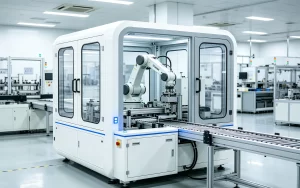
Material selection has a direct impact on an enclosure's durability, appearance, weight, corrosion resistance, and manufacturing cost. Selecting the appropriate material requires balancing mechanical performance with environmental conditions and budget requirements.
Carbon steel remains one of the most widely used materials because of its excellent strength, affordability, and ease of fabrication. It is commonly finished with powder coating to improve corrosion resistance and is suitable for most indoor industrial applications.
Stainless steel is preferred in environments where corrosion resistance and hygiene are critical. Industries such as food processing, pharmaceuticals, medical equipment, and chemical manufacturing frequently use stainless steel enclosures because they resist moisture, cleaning chemicals, and bacterial contamination.
Aluminum has become increasingly popular for automation equipment that requires lightweight construction. Its natural corrosion resistance and excellent machinability make it ideal for robotics, portable equipment, electronics, and precision instruments.
Galvanized steel offers a practical compromise between cost and corrosion protection, making it a common choice for electrical cabinets and indoor automation equipment exposed to moderate environmental conditions.
Designing an automation equipment enclosure involves much more than determining its external dimensions. Engineers must consider structural integrity, thermal management, maintenance accessibility, manufacturing efficiency, and long-term reliability throughout the design process.
The enclosure should provide sufficient structural strength to withstand transportation, vibration, and continuous industrial operation without deformation. Internal mounting points must securely support heavy electrical components while maintaining dimensional stability over time.
Heat management is another critical consideration. Modern automation equipment often contains PLCs, servo drives, industrial PCs, and power electronics that generate substantial heat during operation. Incorporating ventilation openings, cooling fans, heat exchangers, or air conditioning systems helps maintain safe operating temperatures and prevents premature component failure.
Ease of maintenance should also be considered from the beginning. Features such as hinged doors, removable panels, quick-release fasteners, and clearly organized cable routing reduce maintenance time and simplify future upgrades.
Producing high-quality automation equipment enclosures requires a combination of advanced manufacturing technologies and strict quality control.
The process typically begins with CAD engineering and Design for Manufacturability (DFM) analysis, ensuring that every component can be manufactured efficiently while maintaining tight tolerances.
Laser cutting is then used to produce complex profiles with exceptional accuracy and clean edge quality. Compared with conventional cutting methods, laser technology minimizes material waste while improving repeatability.
After cutting, CNC bending forms each sheet metal component into its final geometry. Accurate bending is essential for maintaining assembly precision, especially when multiple panels must fit together seamlessly.
Welding follows to create rigid structural assemblies. Depending on the material and application, TIG, MIG, or spot welding may be selected to achieve the required strength and appearance.
Finally, the enclosure undergoes surface finishing processes such as powder coating, anodizing, brushing, sandblasting, or electropolishing before final assembly and comprehensive quality inspection.
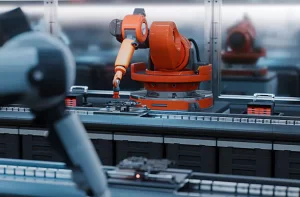
Although standard enclosures are readily available, they rarely meet the unique requirements of specialized automation equipment. Custom sheet metal fabrication enables engineers to optimize every aspect of the enclosure, from internal space utilization and cable routing to cooling performance and external appearance.
A custom-designed enclosure also simplifies assembly by reducing unnecessary brackets, adapters, and modifications. Components fit more precisely, installation becomes faster, and maintenance access can be planned more effectively. For OEM manufacturers, these improvements often translate into lower production costs and higher product quality.
In addition, custom enclosures provide greater flexibility for branding, allowing manufacturers to incorporate company colors, logos, and distinctive industrial designs that strengthen market recognition.
At CTT Technology, we specialize in precision sheet metal fabrication for automation equipment manufacturers worldwide.
From rapid prototypes to high-volume production, we provide complete manufacturing solutions tailored to your project requirements.
Our capabilities include:
Whether you need a compact electrical enclosure, a complex robotic housing, or a large industrial cabinet, our experienced engineering team works closely with you to optimize manufacturability, reduce production costs, and accelerate time-to-market.
Automation equipment enclosures play a fundamental role in protecting industrial machinery, ensuring operator safety, and maintaining reliable equipment performance. From material selection and thermal management to precision fabrication and surface finishing, every stage of the design and manufacturing process contributes to the final product's durability and functionality.
Choosing an experienced sheet metal fabrication partner is essential for achieving high-quality, cost-effective enclosure solutions. With advanced manufacturing technology, comprehensive engineering support, and extensive experience serving global customers, CTT Technology provides custom automation equipment enclosures that combine precision, durability, and manufacturing efficiency. Whether your project involves rapid prototyping, low-volume production, or large-scale manufacturing, we are committed to helping you accelerate product development and deliver reliable automation equipment to the market with confidence.
Explore aerospace sheet metal processing, from precision cutting and forming to welding and finishing, for reliable custom aerospace components.
Discover how advanced CNC technology is transforming custom machined parts with higher precision, faster production, flexible volumes, and smarter manufacturing.
Learn how CNC machining tolerances impact automotive component accuracy and reliability, including standards, key factors, and precision manufacturing solutions.
Discover how precision machining supports HPP equipment manufacturing with high-quality custom metal parts, CNC machining, and sheet metal fabrication solutions.
Email to this supplier
Author:
Ms. CTT TECHNOLOGY (UK) LIMITED
E-mail:
Phone/WhatsApp:

Privacy statement: Your privacy is very important to Us. Our company promises not to disclose your personal information to any external company with out your explicit permission.