




Send Message
Privacy statement: Your privacy is very important to Us. Our company promises not to disclose your personal information to any external company with out your explicit permission.


In pharmaceutical manufacturing, equipment components must meet demanding requirements for cleanliness, corrosion resistance, dimensional accuracy, and long-term reliability. From fluid handling systems and processing vessels to equipment enclosures, brackets, support structures, and precision-machined fittings, every component can influence the hygiene and operational performance of a production line.
Stainless steel is widely used in pharmaceutical equipment because of its mechanical strength, durability, and resistance to corrosion. However, selecting the right stainless steel grade is only part of the manufacturing process. Machining quality, surface roughness, welding integrity, and post-processing treatments are equally important, particularly for components exposed to pharmaceutical products, cleaning agents, and repeated sterilization cycles.
For equipment manufacturers and engineering procurement teams, understanding these factors is essential when sourcing stainless steel machining and fabrication services. This article explores how material selection, precision machining, and surface finishing contribute to reliable pharmaceutical equipment components.
Pharmaceutical production environments place strict demands on equipment materials. Components may encounter water, chemical solutions, cleaning agents, disinfectants, and high-temperature sterilization processes. Materials must maintain their structural integrity while minimizing the risk of corrosion, contamination, and surface degradation.
Stainless steel offers several advantages for pharmaceutical equipment manufacturing:
Stainless steel is not automatically corrosion-proof or hygienic under every operating condition. Its performance depends on the alloy composition, surface condition, exposure environment, and manufacturing quality.
For this reason, stainless steel machining for pharmaceutical applications must consider the complete manufacturing process rather than material selection alone.
Material selection directly affects the corrosion resistance, cleanability, fabrication requirements, and overall cost of pharmaceutical equipment components.
Among commonly used stainless steel grades, 304 and 316L are particularly relevant to pharmaceutical equipment manufacturing.
304 stainless steel is a widely used austenitic stainless steel containing chromium and nickel. It offers good general corrosion resistance, formability, and weldability.
Typical applications include:
However, 304 stainless steel has limitations in environments involving higher chloride concentrations or more aggressive cleaning chemicals. Its suitability should therefore be evaluated against actual operating conditions.
316L stainless steel contains molybdenum, which improves its resistance to pitting and crevice corrosion in many chloride-containing environments compared with 304 stainless steel.
The low-carbon composition also helps reduce the risk of sensitization during welding, making it particularly suitable for fabricated pharmaceutical equipment.
Common applications include:
For applications requiring high corrosion resistance and hygienic performance, 316L is often the preferred material.
Nevertheless, 316L is not immune to corrosion. Chloride concentration, temperature, surface contamination, crevice geometry, and cleaning procedures must all be considered during material selection.
The decision should be based on the component's function and operating environment.
For external structural components that do not contact pharmaceutical products, 304 stainless steel may provide a practical balance between performance and cost. For product-contact surfaces or components exposed to demanding chemical cleaning conditions, 316L is generally a more appropriate starting point.
Selecting the correct grade at the design stage helps prevent unnecessary material costs while maintaining the required equipment performance.
The corrosion resistance of stainless steel depends not only on its chemical composition but also on the condition of its surface.
Stainless steel naturally forms a thin, chromium-rich passive oxide film when exposed to oxygen. This protective layer helps prevent further oxidation and supports long-term corrosion resistance.
However, machining and fabrication can introduce surface conditions that compromise this protection.
1. Embedded iron contamination
Using contaminated cutting tools, grinding equipment, or handling surfaces can transfer free iron particles onto stainless steel. These particles may rust and create localized corrosion sites.
Dedicated or properly cleaned tooling and controlled handling procedures help reduce this risk.
2. Heat-affected zones from welding
Welding generates localized heat that can cause discoloration, oxide formation, and changes in the surface condition. Poorly controlled welding and inadequate post-weld cleaning may reduce corrosion resistance.
For pharmaceutical equipment, welding procedures should be controlled, and weld areas should be appropriately cleaned, inspected, and finished.
3. Surface scratches and machining marks
Deep scratches, sharp transitions, and rough machining marks can retain product residues and cleaning chemicals. These areas may become more difficult to clean and can contribute to localized corrosion under certain conditions.
Proper machining parameters, deburring, and finishing help reduce these risks.
4. Improper chemical treatment
Incorrect pickling, passivation, or chemical handling procedures may damage the surface rather than improve it. Post-processing should be selected according to the material grade, application, and applicable specifications.
Corrosion resistance is therefore a manufacturing quality issue as much as a material property.
Surface finish is one of the most important considerations when manufacturing stainless steel pharmaceutical components.
A rough or poorly finished surface can create microscopic valleys, scratches, and irregularities where product residues, microorganisms, or cleaning chemicals may accumulate. These conditions can increase cleaning difficulty and create potential contamination risks.
Surface roughness is commonly measured using the Ra parameter, which represents the arithmetic average deviation of a surface profile from its mean line.
For pharmaceutical processing equipment, the required Ra value depends on whether a surface contacts the product, the cleaning and sterilization procedures, and the applicable equipment specification.
Typical engineering reference values include:
These values are not universal regulatory limits. The actual acceptance criteria should be defined by the equipment design, customer requirements, and applicable standards, such as ASME BPE.
Importantly, achieving a specified Ra value does not automatically guarantee hygienic performance. Surface defects, weld geometry, crevices, and accessibility for cleaning must also be considered.
Mechanical Polishing
Mechanical polishing uses abrasive materials to remove surface irregularities and improve surface smoothness.
It is commonly used for stainless steel panels, equipment housings, machined components, and fabricated assemblies. The abrasive sequence and polishing direction should be controlled to achieve consistent results.
Electropolishing
Electropolishing is an electrochemical process that removes a thin layer of material from the stainless steel surface.
It can improve surface smoothness, reduce microscopic irregularities, and support the formation of a corrosion-resistant passive surface.
For pharmaceutical and biopharmaceutical applications, electropolishing is particularly useful for components requiring improved cleanability and controlled surface characteristics.
However, electropolishing should be considered a finishing process rather than a substitute for proper machining or sanitary design. The final surface must still be inspected against the specified requirements.
Chemical Passivation
Passivation is a chemical treatment used to remove free iron contamination and support the formation of a protective passive film.
For stainless steel components, passivation is often performed after machining, welding, or other operations that may introduce surface contamination.
ASTM A967/A967M is a commonly referenced specification for chemical passivation treatments of stainless steel parts.
Mechanical polishing, electropolishing, and passivation serve different purposes. They may be used individually or in combination depending on the application and required surface condition.
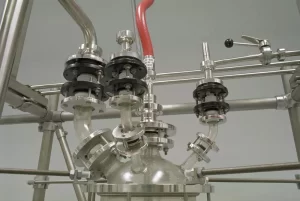
Pharmaceutical equipment often combines precision-machined parts with fabricated sheet metal structures and welded assemblies.
A component may require accurate mounting holes, smooth internal passages, consistent wall thickness, or carefully controlled interfaces with seals and connecting fittings.
Manufacturing quality must therefore address both dimensional accuracy and surface integrity.
CNC Milling and Turning
CNC machining is used to manufacture complex stainless steel components with controlled dimensions and repeatable geometries.
Typical parts include valve bodies, connectors, equipment fittings, brackets, and precision mounting components.
For 316L stainless steel, tool selection, cutting speed, feed rate, cooling, and chip evacuation must be carefully controlled because the material can work-harden during machining.
Laser Cutting and Sheet Metal Fabrication
Laser cutting enables accurate production of stainless steel sheet metal components, including equipment panels, enclosures, brackets, and structural covers.
Bending, forming, and precision assembly are then used to create the required geometry.
For pharmaceutical equipment, edge quality, dimensional consistency, and the elimination of burrs and sharp edges are particularly important.
Welding and Assembly
Welding joins stainless steel components into equipment structures and functional assemblies.
Depending on the design, TIG welding and other qualified welding processes may be used. Welding parameters, joint preparation, heat input, and post-weld finishing all influence the final component quality.
For hygienic applications, welds should be designed to minimize crevices and provide surfaces that can be effectively cleaned.
Design for Manufacturability (DFM) helps identify potential manufacturing difficulties before production begins.
For pharmaceutical equipment components, DFM reviews should consider:
Early collaboration between equipment designers and manufacturing suppliers can reduce unnecessary complexity, improve production consistency, and control total manufacturing costs.
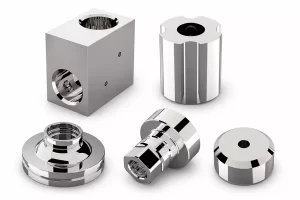
For pharmaceutical equipment manufacturers, consistent quality is essential. A component that meets dimensional requirements but fails to achieve its specified surface finish or corrosion resistance may still be unsuitable for its intended application.
A comprehensive quality control process should cover multiple manufacturing stages.
Material verification: Confirm the stainless steel grade and maintain appropriate material documentation, such as mill test certificates and material traceability records when required.
Dimensional inspection: Use appropriate measuring equipment to verify critical dimensions, tolerances, hole positions, flatness, and assembly interfaces.
Surface roughness measurement: Use a calibrated surface profilometer to verify that the finished component meets the specified Ra requirements.
Weld inspection: Examine weld appearance, continuity, surface condition, and other acceptance criteria defined by the engineering specification.
Post-treatment inspection: Verify that cleaning, passivation, or electropolishing has been completed according to the agreed process requirements.
Final documentation: Maintain inspection reports, material records, and relevant process documentation to support customer quality requirements and traceability.
Standards such as ASME BPE provide important guidance for the design and fabrication of equipment used in bioprocessing and pharmaceutical manufacturing. However, compliance requirements depend on the equipment type, intended application, and project specification.
Stainless steel machining for pharmaceutical equipment requires a coordinated approach to material selection, precision manufacturing, corrosion protection, and surface finishing.
While 304 stainless steel is suitable for many general structural applications, 316L is often preferred for product-contact components and demanding pharmaceutical environments. At the same time, machining quality, welding control, surface roughness, and appropriate post-processing treatments are essential to achieving the required performance.
For pharmaceutical equipment OEMs, working with a manufacturing partner that understands both precision machining and custom sheet metal fabrication can simplify component sourcing and improve production consistency.
CTT Technology supports custom metal component manufacturing for industrial and specialized equipment applications, from rapid prototyping to low-volume and high-volume production. Through engineering collaboration, precision fabrication, and attention to manufacturing quality, CTT Technology helps equipment manufacturers turn technical drawings into reliable components.

2024-08-01
Advantages of stainless steel flange
2026-05-07
Precision Metal Parts for Robotics Industry
2024-08-15
Main steps in sheet metal processingExplore stainless steel machining for pharmaceutical equipment, including 316L material selection, corrosion resistance, surface finishing, and precision fabrication.
Discover custom metal enclosures for scientific instruments. Explore precision sheet metal fabrication, material selection, and scalable manufacturing solutions.
Discover how precision machining and custom sheet metal fabrication improve battery PACK enclosures, structural integrity, and manufacturing consistency.
Discover how CNC machining supports cell culture and bioprocessing equipment with precision components, custom sheet metal fabrication, and scalable manufacturing.
Email to this supplier
Author:
Ms. CTT TECHNOLOGY (UK) LIMITED
E-mail:
Phone/WhatsApp:

Privacy statement: Your privacy is very important to Us. Our company promises not to disclose your personal information to any external company with out your explicit permission.