








Send Message
Privacy statement: Your privacy is very important to Us. Our company promises not to disclose your personal information to any external company with out your explicit permission.


Precision machining plays a vital role in modern manufacturing, enabling industries such as automotive, aerospace, medical devices, and electronics to produce high-quality and highly accurate components. As product designs become more complex and tolerance requirements continue to increase, advanced machining technologies are essential for ensuring precision, efficiency, and consistent production quality.
Among the most commonly used precision manufacturing methods are CNC milling machining and EDM (Electrical Discharge Machining). Although both processes are used to create precise metal parts, they differ significantly in working principles, material compatibility, production cost, and machining capability. Understanding these differences can help manufacturers and engineers choose the most suitable machining method for their specific applications.
CNC milling machining is a subtractive manufacturing process that uses computer-controlled rotating cutting tools to remove material from a workpiece and create precise shapes, holes, and surfaces. The process is widely used for manufacturing metal and plastic parts with high accuracy and efficiency. CNC milling supports various materials and production volumes, making it ideal for rapid prototyping, custom components, and large-scale production in industries such as automotive, aerospace, electronics, and industrial equipment.
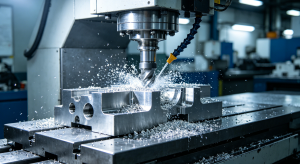
EDM (Electrical Discharge Machining) is a non-contact machining process that removes material through controlled electrical sparks between an electrode and a conductive workpiece. Unlike traditional cutting methods, EDM does not rely on mechanical force, allowing it to machine extremely hard materials and highly complex geometries with exceptional precision. EDM is commonly used for mold manufacturing, precision tooling, medical components, and aerospace parts that require tight tolerances and intricate internal features.
Although both EDM machining and CNC milling are widely used in precision manufacturing, the two processes operate in completely different ways and are suited for different production needs. Understanding their key differences can help manufacturers choose the most efficient and cost-effective machining solution.
The working principles of EDM machining and CNC milling differ, with the main difference being the method of material removal. CNC milling removes material through mechanical cutting using a rotating tool. The cutting tool directly contacts the workpiece and gradually shapes the part through continuous cutting operations.
EDM machining, on the other hand, removes material using controlled electrical discharges (sparks). Instead of mechanical cutting, the material is eroded by the thermal energy generated from sparks between the electrode and the workpiece. Since EDM does not rely on mechanical cutting forces, it is especially suitable for machining delicate or extremely hard materials.
Beyond the working principle, these two machining methods also differ in terms of material compatibility, precision and surface finish, machining speed and efficiency, geometric complexity, as well as tool wear and mechanical stress. The details are summarized in the following table:
| Factor | CNC Milling | EDM Machining |
| Material Removal | Mechanical cutting | Electrical spark erosion |
| Material Compatibility | Most materials | Conductive materials only |
| Machining Speed | Faster | Slower |
| Precision | High | Extremely high |
| Surface Finish | Good | Excellent |
| Complex Geometry | Moderate | Excellent |
| Mechanical Stress | Present | Minimal |
| Hard Material Capability | Limited | Excellent |
| Production Cost | Lower | Higher |
| Best For | General production | Precision & complex parts |
CNC milling is widely used in manufacturing due to its high efficiency, low cost, and broad material compatibility. Here are some scenarios where CNC milling is ideal:
In general, if the part does not contain extremely complex internal structures or super-hard materials, CNC milling is usually the most economical and efficient choice.
EDM machining is more suitable for applications requiring high precision, complex geometry, or very hard materials:
If a project demands extreme precision or complex internal structures, EDM is often irreplaceable, despite longer processing time and higher cost.
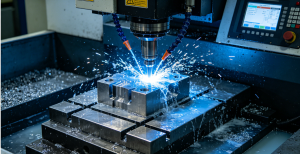
In modern manufacturing, CNC milling and EDM are often used together to balance efficiency and precision:
Typical workflow:
CNC roughing: Quickly removes the bulk of the material and forms the basic shape.
EDM finishing: Refines complex details, cavities, or micro-tolerances to achieve high-precision surfaces.
Advantages:
Hybrid machining is a common strategy in mold making, aerospace parts, and high-precision medical device manufacturing.
| Factor | CNC Milling | EDM Machining |
| Material Type | Common metals or plastics | Conductive and very hard materials |
| Precision Requirements | General precision | Ultra-high precision or micro-features |
| Part Geometry Complexity | External contours, slots, holes, standard 3D shapes | Deep cavities, sharp internal corners, complex internal structures |
| Production Volume & Cost | Large-volume production, cost-sensitive | Single-piece or small-batch, complex parts |
| Lead Time | Tight deadlines, fast prototypes | Precision parts where slower processing is acceptable |
Decision recommendation:
Both CNC milling and EDM machining have unique advantages:
CNC Milling: Efficient, cost-effective, and versatile, making it ideal for high-volume production and rapid prototyping.
EDM Machining: Offers extremely high precision, excels in complex geometries and hard materials, but is slower and more expensive.
In practice, choosing the right machining method affects not only cost but also part quality and lead time. Many advanced manufacturing projects use a CNC + EDM hybrid approach to achieve the optimal production solution.
Discover how CTT Technology manufactures precision automotive parts—from engineering design to mass production. Explore our expertise in heavy truck components, bus chassis panels, CNC machining services, and custom CNC parts.
Explore compliance-driven precision manufacturing for medical devices, including custom production, full quality control, and engineering support for imaging, diagnostics, and life science equipment.
Discover precision metal parts for robotics with custom sheet metal fabrication, CNC machining, and scalable manufacturing solutions.
Benefiting from the booming biopharmaceutical industry and accelerated domestic substitution, the market for core equipment solutions for life sciences is experiencing rapid growth. This article focuses on global and Chinese market size forecasts, dissecting the core drivers of industry growth to help seize industry development opportunities.
Email to this supplier
Author:
Ms. CTT TECHNOLOGY (UK) LIMITED
E-mail:
Phone/WhatsApp:

Privacy statement: Your privacy is very important to Us. Our company promises not to disclose your personal information to any external company with out your explicit permission.