







Send Message
Privacy statement: Your privacy is very important to Us. Our company promises not to disclose your personal information to any external company with out your explicit permission.


As the global electric vehicle (EV) market continues to expand, the demand for high-performance EV battery systems is growing rapidly. Battery packs are the core component of electric vehicles, directly influencing driving range, safety, thermal management, and overall vehicle performance. To ensure durability and reliability, manufacturers increasingly rely on precision sheet metal processing for the production of EV battery enclosures, brackets, cooling structures, and supporting assemblies.
EV battery systems operate under demanding conditions involving heat generation, vibration, moisture exposure, and mechanical stress. Precision sheet metal components provide the structural integrity and protection necessary for long-term battery performance.Key functions of sheet metal parts in EV battery systems include:
Modern EV manufacturers require lightweight yet durable battery enclosures, making aluminum, stainless steel, and coated steel common choices for sheet metal fabrication.
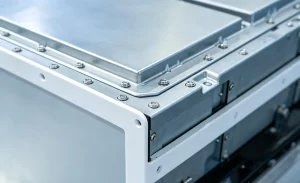
Battery Enclosures
Battery enclosures are among the most critical structural components in electric vehicles. These housings must withstand vibration, collision impact, and environmental exposure while maintaining lightweight performance.
Precision sheet metal fabrication enables:
Aluminum sheet metal is widely used because of its lightweight properties and excellent heat dissipation capabilities.
Mounting Brackets and Support Structures
Battery systems contain numerous internal modules and electrical components that require secure mounting. Sheet metal brackets and support frames help maintain component stability during vehicle operation.
Typical applications include:
Custom CNC bending and laser cutting technologies ensure accurate assembly and consistent production quality.
Cooling and Thermal Management Components
Temperature control is essential for EV battery safety and efficiency. Sheet metal processing supports the manufacturing of cooling plates, airflow channels, and heat dissipation structures.
Advanced fabrication techniques help manufacturers achieve:
Efficient thermal management extends battery lifespan and improves charging performance.
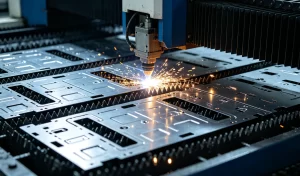
Laser Cutting
Laser cutting provides high-speed and high-precision fabrication for complex EV battery components. It allows manufacturers to create intricate geometries with minimal material waste.
Advantages include:
Laser cutting is particularly suitable for aluminum and stainless steel battery enclosure parts.
CNC Bending
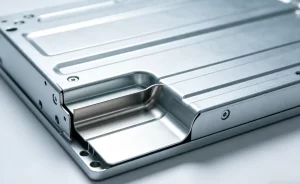
CNC bending is essential for forming battery housings and structural frames with precise angles and repeatable accuracy.
Benefits include:
Precision bending ensures proper fitment during battery pack assembly.
Welding and Assembly
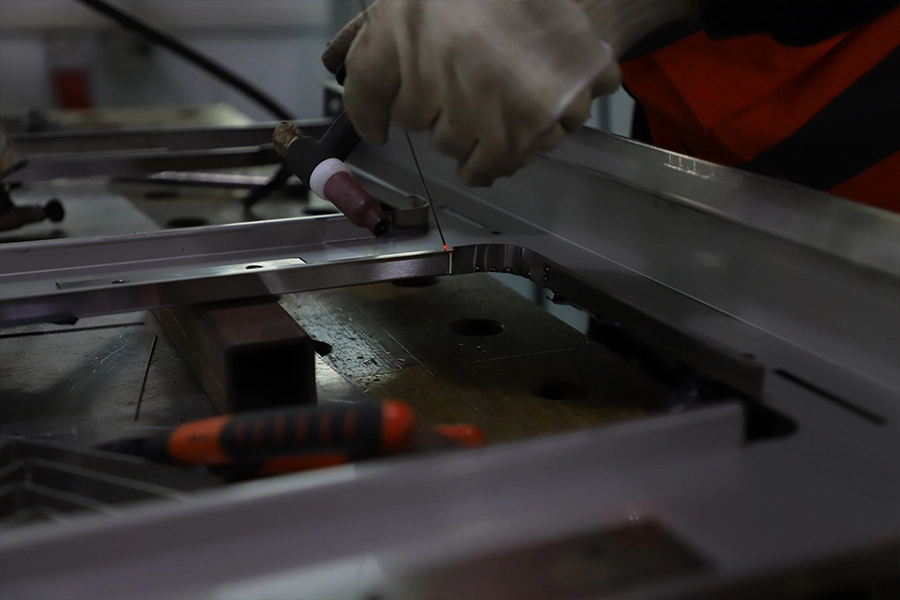
EV battery systems often require complex welded structures that combine strength with airtight sealing performance.
Common welding methods include:
Professional welding processes improve structural durability and help achieve reliable battery protection.
Surface Finishing
Surface treatment enhances corrosion resistance, electrical insulation, and aesthetic quality.
Popular finishing options include:
Proper surface finishing extends component lifespan in harsh automotive environments.
Material selection directly impacts battery performance, weight, and safety.
Aluminum
Aluminum is widely used in EV battery systems because it offers:
Stainless Steel
Stainless steel is suitable for applications requiring higher strength and durability.
Advantages include:
Galvanized Steel
Galvanized steel provides a cost-effective solution for certain support structures and protective components.
Advantages of Galvanized Steel:
As electric vehicle technology continues to evolve, the future of EV metal fabrication will focus on lightweight materials, higher precision, and smarter manufacturing processes. Advanced sheet metal fabrication technologies such as automated laser cutting, robotic welding, and AI-driven quality inspection are helping manufacturers improve production efficiency while maintaining strict quality standards. At the same time, the growing demand for longer battery range and faster charging is driving the development of thinner, stronger, and more thermally efficient metal components. In the future, EV metal fabrication will play an even more important role in supporting sustainable, high-performance electric vehicle production.
As electric vehicles continue to reshape the automotive industry, precision sheet metal processing plays an increasingly important role in EV battery system manufacturing. From lightweight battery enclosures to complex thermal management structures, high-quality sheet metal components directly affect battery safety, efficiency, and long-term reliability.
By combining advanced fabrication technologies, strict quality control, and scalable manufacturing capabilities, companies can produce EV battery components that meet the evolving demands of the modern electric vehicle market.
Explore aerospace sheet metal processing, from precision cutting and forming to welding and finishing, for reliable custom aerospace components.
Discover how advanced CNC technology is transforming custom machined parts with higher precision, faster production, flexible volumes, and smarter manufacturing.
Discover how precision machining supports HPP equipment manufacturing with high-quality custom metal parts, CNC machining, and sheet metal fabrication solutions.
Discover how laser cutting technology helps automotive manufacturers reduce hot forming costs while achieving superior laser cutting accuracy and meeting laser cutting tolerance standards. Learn how precision sheet metal fabrication improves quality, productivity, and profitability.
Email to this supplier
Author:
Ms. CTT TECHNOLOGY (UK) LIMITED
E-mail:
Phone/WhatsApp:

Privacy statement: Your privacy is very important to Us. Our company promises not to disclose your personal information to any external company with out your explicit permission.