








Send Message
Privacy statement: Your privacy is very important to Us. Our company promises not to disclose your personal information to any external company with out your explicit permission.


Modern manufacturing demands products that are lighter, stronger, more precise, and faster to produce. Whether you're developing automotive brackets, aerospace enclosures, medical device housings, or industrial equipment, thoughtful sheet metal parts design directly impacts manufacturing efficiency, product quality, and overall production costs.
Successful sheet metal processing begins long before the first sheet enters a laser cutting machine. By incorporating Design for Manufacturability (DFM) principles during product development, engineers can reduce production time, minimize material waste, and improve assembly performance.
In this guide, we'll explore practical design tips that help optimize sheet metal components while maximizing manufacturing efficiency.
Material selection is one of the most important aspects of sheet metal processing.
Common materials include:
When selecting materials, engineers should consider:
For example, aluminum is ideal for lightweight applications, while stainless steel provides superior corrosion resistance for medical and food equipment.
Maintaining consistent bend radii is one of the simplest yet most effective ways to improve the manufacturability of sheet metal parts. As a general rule, the inside bend radius should be equal to or greater than the material thickness to reduce the risk of cracking and material deformation. Using uniform bend radii throughout a design also improves bending accuracy, minimizes tooling changes, shortens setup times, and ensures more consistent results across production runs. By standardizing bend dimensions during sheet metal processing, manufacturers can achieve higher efficiency, lower production costs, and better overall part quality.
Every additional bend increases:
Whenever possible:
Simpler designs improve throughput without sacrificing functionality.
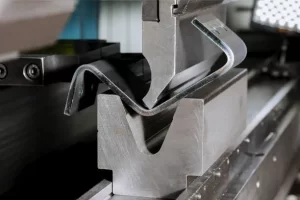
Poor hole placement frequently causes deformation during bending.
Recommended practices include:
Proper spacing preserves structural integrity and improves manufacturing accuracy.
Manufacturing tolerances have a significant impact on the cost, quality, and efficiency of sheet metal parts production. While tight tolerances are essential for critical features and precision assemblies, applying them to every dimension can unnecessarily increase machining time, inspection requirements, and overall manufacturing costs. Instead, designers should specify tighter tolerances only where they are functionally required and use standard tolerances for non-critical features. By balancing precision with manufacturability, companies can streamline sheet metal processing, reduce production complexity, and achieve high-quality parts at a more competitive cost.
Sharp internal corners create stress concentrations and increase laser cutting time.
Instead, designers should:
Benefits include:
Efficient welding design is essential for improving the strength, consistency, and manufacturability of sheet metal parts. A well-designed component should minimize unnecessary welds while providing adequate access for welding equipment and maintaining consistent joint gaps. Incorporating self-locating features and designing simple, accessible weld joints can reduce assembly time, improve weld quality, and minimize distortion during fabrication. By considering welding requirements early in the sheet metal processing stage, manufacturers can lower labor costs, enhance production efficiency, and deliver more reliable, high-quality assemblies.
Standardization simplifies production.
Examples include:
Benefits include:
Standard designs are especially valuable in medium- and high-volume production.
Material accounts for a significant portion of manufacturing costs.
Efficient nesting helps:
Designers should avoid unnecessarily large blank sizes and irregular geometries that waste material.
Involving your manufacturing partner early in the design process is one of the most effective ways to improve the efficiency and quality of sheet metal parts production. Experienced sheet metal manufacturers can review your design from a Design for Manufacturability (DFM) perspective and recommend improvements to material selection, part geometry, bend design, tolerances, and manufacturing methods. This early collaboration helps identify potential production challenges before fabrication begins, reducing costly design revisions, minimizing lead times, and optimizing the overall sheet metal processing workflow. By working closely with your manufacturing partner from the outset, you can achieve a more cost-effective, reliable, and production-ready design.
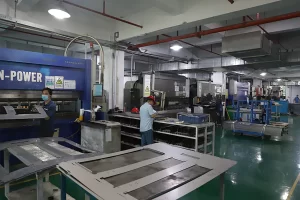
At CTT technology, manufacturability is integrated into every project from the beginning.
Our engineering team works closely with customers to optimize sheet metal parts for both performance and production efficiency.
Our capabilities include:
We serve customers across industries including:
From simple brackets to complex welded assemblies, we deliver precision-engineered solutions with consistent quality and reliable lead times.
Efficient sheet metal parts design is not only about creating functional products—it is about enabling smarter manufacturing.
By selecting appropriate materials, simplifying geometries, optimizing bends, standardizing features, and collaborating with experienced manufacturers, companies can significantly reduce production costs while improving quality and delivery speed.
Whether you need a rapid prototype or full-scale production, applying these design principles will maximize the efficiency of your sheet metal processing projects and help bring better products to market faster.
Learn how DFM improves CNC bending accuracy, reduces defects, and lowers production costs with practical sheet metal design tips.
Learn everything about GD&T in CNC machining, including symbols, benefits, and best practices. Improve CNC machining precision and optimize CNC machining tolerances.
Learn essential sheet metal design guidelines for bends, DFM principles, and aluminum part fabrication. Discover how CNC bending, precision sheet metal processing, and CNC sheet metal bending improve manufacturability, accuracy, and production efficiency.
Learn how Design for Manufacturing (DFM) reduces production costs, improves quality, and optimizes sheet metal fabrication, laser cutting tolerances, and CNC machining.
Email to this supplier
Author:
Ms. CTT TECHNOLOGY (UK) LIMITED
E-mail:
Phone/WhatsApp:

Privacy statement: Your privacy is very important to Us. Our company promises not to disclose your personal information to any external company with out your explicit permission.