







Send Message
Privacy statement: Your privacy is very important to Us. Our company promises not to disclose your personal information to any external company with out your explicit permission.


In modern industrial production, precision manufacturing, as a key technology, is gradually driving progress and innovation across various industries. Among the many processes in precision manufacturing, bending technology is undoubtedly one of the most important. Bending not only changes traditional metal processing methods but also significantly improves production efficiency, product quality, and manufacturing accuracy. So, how does bending technology in precision manufacturing specifically enhance industrial production? Let's explore.
Precision manufacturing refers to a highly refined production process aimed at producing parts or products with extremely high precision. Unlike traditional manufacturing methods, precision manufacturing uses modern technologies and equipment such as CNC machines, laser cutting, and laser engraving, ensuring the high precision and complexity of parts at the micron level. It is widely applied in high-end fields like aerospace, automotive, electronics, and medical industries.
Core characteristics of precision manufacturing are:

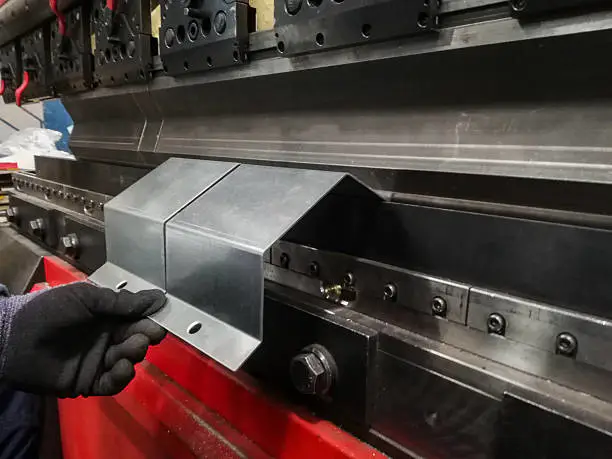
Bending is a common metalworking process used to bend metal sheets, bars, or other metal materials through the application of external forces. It can be used for various types of metal materials, including steel, aluminum, and copper, and is widely applied in automotive manufacturing, construction, and electronics.
The principle of bending generally involves using molds and pressure to deform the metal material along a specific bending angle. Throughout the process, the material's stress is evenly distributed, forming the desired shape. Bending technology can be divided into several types, including air bending, V-bending, and springback bending. Choosing the right bending method helps improve product quality and production efficiency.
Bending technology plays a crucial role in precision manufacturing, especially in the production of precision metal components. Its application leads to several improvements:
Precision manufacturing relies on high accuracy, and bending technology is a key factor in ensuring this. By using high-precision CNC bending machines and advanced bending techniques, manufacturers can bend metal materials to precise angles and shapes. Particularly in the production of parts with complex geometries, bending technology ensures that the dimensional error of each component is minimized, greatly enhancing product consistency and reliability.
Traditional metalworking methods (such as welding, casting, etc.) typically require multiple steps, while bending can complete the forming of most metal parts in a single operation, significantly shortening the production cycle. Additionally, bending requires no extra welding materials or complex post-processing steps, which can substantially reduce production costs. This is especially true for mass production, where bending technology helps manufacturers improve efficiency and save raw materials.

Bending can create a natural stress distribution in the structure of metal materials, helping to increase the strength and durability of parts. By selecting appropriate bending angles and methods, bending technology ensures the durability of parts, reducing damage from external impacts or prolonged use. For example, in the automotive industry, car body parts made using precision bending technology can withstand greater pressure, improving vehicle safety.
As industrial product designs become increasingly complex, bending technology enables manufacturers to achieve more refined and intricate designs. Modern precision bending machines can handle not only common simple bending tasks but also complex multi-angle bends, accommodating irregular geometric shapes. This allows manufacturers to fully unleash their creativity during the design phase, producing high-precision, customized products that meet modern demands.
The widespread application of bending technology in precision manufacturing makes it an essential element in many industries:
Bending technology plays an indispensable role in precision manufacturing. It not only enhances product precision and quality but also helps manufacturers reduce production costs and time while increasing product durability and strength. With the continuous development of modern bending technology, more industries are integrating this process into their production workflows, driving the transformation and upgrading of industrial manufacturing.
Whether in the automotive, electronics, or aerospace industries, bending technology provides strong support for improving product precision and performance. For manufacturers, mastering bending technology is undoubtedly the key to enhancing competitiveness and meeting market demands.
Learn how DFM improves CNC bending accuracy, reduces defects, and lowers production costs with practical sheet metal design tips.
Learn everything about GD&T in CNC machining, including symbols, benefits, and best practices. Improve CNC machining precision and optimize CNC machining tolerances.
Learn how Design for Manufacturing (DFM) reduces production costs, improves quality, and optimizes sheet metal fabrication, laser cutting tolerances, and CNC machining.
Learn everything about CNC machining tolerances, including standard tolerance ranges, ISO standards, GD&T, cost factors, and how precision CNC machining improves quality.
Email to this supplier
Author:
Ms. CTT TECHNOLOGY (UK) LIMITED
E-mail:
Phone/WhatsApp:

Privacy statement: Your privacy is very important to Us. Our company promises not to disclose your personal information to any external company with out your explicit permission.